Math, the Universe, and Everything: An Invisible Bridge
How can it be that mathematics, being after all a product of human thought which is independent of experience, is so admirably appropriate to the objects of reality?
The more I study math, the more I stand in awe of it. That’s kind of a weird thing to say, given that I don’t really think math gets more “confusing” the more you study it—more complicated, sure, but not more confusing. The subject always “makes sense”—you start with some axioms, you sort out the implications of those axioms, you examine what happens when you combine them and apply the pressure of logic to them, and voila!—all of a sudden, you have made math happen. There’s nothing exceptionally crazy or awesome about that; in fact, everything you do in math has to be strictly logical, or else you end up making mistakes and “proving” statements that aren’t true (faulty logic = anti-math, we might say). And yet, despite the fact that mathematics always remains within the realm of the logical, the discoveries we arrive at by slowly building upon our chosen axioms never cease to astound me.
Here’s a great example—you may have heard that Earth orbits the sun in an ellipse. If you are familiar with the concept of an ellipse (and perhaps more broadly familiar with the concept of conic sections), you may also be familiar with the term eccentricity. The eccentricity of an ellipse is defined as the ratio of the distance between the ellipse’s focal points (or foci) and the length of its major axis (the longest possible distance you can take to cross the ellipse in a straight line). If the distance from the center of the ellipse to one of its foci is c and the distance from the center of the ellipse to one of its vertices along the major axis is a, we arrive at the following formula for the ellipse’s eccentricity, e:
\[e = {2c \over 2a} = \frac{c}{a}\]
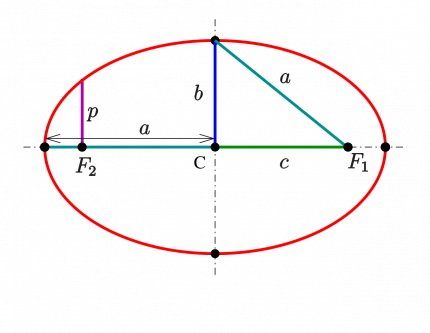
By Ag2gaeh – Own work, CC BY-SA 4.0, Link.
Okay, then, no problem—clearly, as long as we know the lengths c and a, we can calculate the eccentricity of the ellipse quite easily. But what does the value of e actually tell us about the ellipse? Let’s think about that for a second. When e is small—close to 0, let’s say—the formula above indicates that the distance between the ellipse’s foci is very small compared to the length of its major axis. This suggests that the ellipse is not “stretched out” very much along the major axis; the smaller the value of e, the rounder the ellipse, and the more it starts to look like a circle. In fact, we can even define a circle as an ellipse with an eccentricity of 0, as shown in the diagram below.
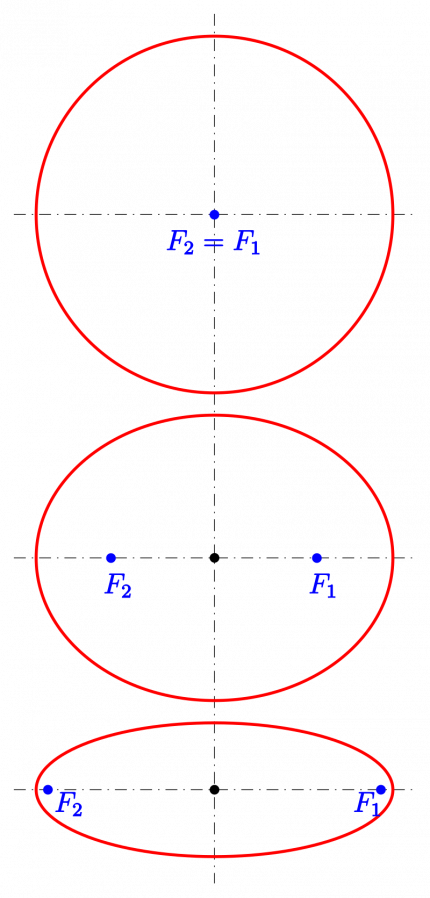
By Ag2gaeh – Own work, CC BY-SA 4.0, Link.
Meanwhile, if we have an ellipse with a larger value for e, like 0.999 (picture an ellipse like the one at the bottom of the preceding picture, but stretched so thin it starts to look like a line), the high eccentricity value tells us that the distance between foci comes very close to spanning the full length of the major axis.A Visually, this means our ellipse looks narrow and stretched out, kind of like somebody pinched two opposing points on a circle and pulled them outward.
With a little bit of effort, you can probably verify that this all makes sense mathematically. However, unless you’re someone who just likes to do math for fun (i.e., a nerd like me), you might be thinking, “So, what’s the point? Why should I care about this mathematical construct that we call eccentricity? WHAT HAS ECCENTRICITY DONE FOR ME LATELY, DAMN IT?!”B
Well, here’s one consideration that might add a little weight and intrigue to our discussion of eccentricity. Remember, we initially started our inquiry into ellipses with the observation that Earth, our lovely ball of molten metal coated in rock coated in water and air, orbits the sun in an elliptic pattern. Given that observation, think how lucky we are (or perhaps, how necessary it is to our existence), that the ellipse the Earth travels along has a very low eccentricity of e ≈ 0.0167. Since low values of e correspond to “fatter” ellipses, the low eccentricity of Earth’s orbit tells us that we travel around the sun almost in a circle. Good thing, too—if Earth had the eccentricity of Halley’s comet (e ≈ 0.97) instead, I imagine things would start to get too cold for my taste pretty quickly!
Furthermore, think about what would happen if an object came into our solar system and banked around the sun at a high speed, faster than the speed of Earth’s orbit. Picture it in your head: if we ignore the gravitational influence of other objects besides the sun, the object basically enters the solar system moving in a straight line, banks closer to the sun in response to the sun’s gravitational force, and then shoots out of the solar system in a new direction. What type of curve does the object trace? If you’ve studied a bit of geometry and have a penchant for visual thinking, you may have guessed it already—a hyperbola! (Or half of one, at least.) Think about how crazy that is for a second—at a basic level, the paths of real, physical objects in the solar system trace out nothing other than good old conic sections, purely mathematical constructs defined by the intersection of planes and cones.C
This is one of many components of what one might call the “bridge” between math and physics—the bridge being the complete set of examples of how mathematical structures apply to tangible, physical objects in the universe. The fact that examples of this sort appear all throughout the natural world absolutely blows my mind, and it has garnered attention from virtually anyone to have ever studied physics with even a remote degree of seriousness—including and especially Einstein, whom I quoted at the beginning of this essay.
To better understand Einstein’s perspective on the relationship between math and physics, I highly recommend reading the transcript of the lecture from which I took the epigraph up above. In the lecture, Einstein gives perhaps a more complex and interesting explanation for what Eugene Wigner later called the “Unreasonable Effectiveness of Mathematics in the Natural Sciences” than the epigraph quote suggests. Perhaps surprisingly, Einstein (at this stage of his career, at least) did not believe in the existence of any particular quality of the universe that links math to physics. To the contrary, in fact, he famously stated, “As far as the laws of mathematics refer to reality, they are not certain; and as far as they are certain, they do not refer to reality.” He followed this up with a more detailed explanation later in the lecture, declaring, “Geometry (G) predicates nothing about the relations of real things, but only geometry together with the purport (P) of physical laws can do so. Using symbols, we may say that only the sum of (G) + (P) is subject to the control of experience. Thus (G) may be chosen arbitrarily, and also parts of (P); all these laws are conventions. All that is necessary to avoid contradictions is to choose the remainder of (P) so that (G) and the whole of (P) are together in accord with experience. Envisaged in this way, axiomatic geometry and the part of natural law which has been given a conventional status appear as epistemologically equivalent.”
Sheesh—that was a mouthful, Albert! In simpler terms, Einstein is saying that we see a connection between math and physics primarily because we can freely choose our geometric axioms—these axioms do not depend on observation and experience. We can likewise choose some physical conventions freely. When we choose to work with the geometric axioms and physical conventions that most effectively generate descriptions of the world we actually observe, it should come as no surprise that our mathematics jives with our physics, so to speak. There is no need, in Einstein’s perspective (circa the time of this lecture), to assert a cosmic, mystical explanation for the effectiveness of math in the natural sciences. All we’re doing as physicists, after all, is mapping our mathematical constructs onto the physical world in whatever manner best agrees with our experience and observations. The mathematical constructs we use in physics never have any absolute ties to nature, and they are always subject to revision. Although this line of thinking may seem incongruous with some of Einstein’s most widely shared quotations (including the one that constitutes the epigraph of this essay), those familiar with Einstein’s legacy will understand that he, of all people, had tremendous reason to doubt the necessity of a connection between any particular form of geometry and the mechanics of physical reality.
I, on the other hand, tend to be more of a true believer in the substance of the math-physics bridge, even when we pit the notion of the bridge against the skepticism of one of history’s greatest scientists. In my mind, I believe the reason we observe so many physical phenomena that appear to be related to mathematics is simply that they are related to mathematics. I think mathematics undergirds the physical reality we observe and interact with, and of which we ourselves are a part. That’s a deep claim, and a fairly controversial one to this day, and I hope those of you who read this will spend some time thinking about it. If true, it implies that our universe is built upon mathematical structures, and that we are, in a sense, mathematical beings by nature.D
Notes
- I adapted this essay from a discussion post I initially wrote for a college math class. Because my homework deserves to be shared with the world, damn it.
- The featured image for this post, as well as the ellipse diagrams in it, were created by Wikipedia user Ag2gaeh. They are the user’s own work and are licensed under CC BY-SA 4.0 (link for featured image). I am using them here for educational purposes; however, if the author prefers that I don’t use them, he may contact me and I will gladly take them down.
- I was unable to verify the translator(s) of the Einstein lecture “Geometry and Experience” quoted in this essay. However, the page hosting the text states that it was originally published in 1922 by Methuen & Co. Several internet search results indicate that this version was translated by G.B. Jeffery and W. Perrett.
Published: December 27, 2021.
Last edit: March 20, 2022.